
The Building Type you choose for your Barndominium can affect your Barndo plans in many ways!
Things to consider:
- Steel or Wood Structure?
- Will you construct it, or can you find a company that does?
- Water resistance: how sealed is it?
- Column Size: Will determine the thickness of your external walls.
- Column Spacing (bay width): How strong would you like your home to be?
- Column placement (will you expose columns or hide them in walls?).
- Truss type: Will it be easy to place your walls inside?
- Height: Will you want 8, 9, or 10-foot ceilings with attic space?
- Wind and Snow load: The pitch of the roof and strength of the framework are essential.
- Are wood studs or light-gauge metal wall framing best for your area?
- When should you consider galvanized steel for your framework?
- Do you need a pre-engineered building? Check with your county for their code requirements.
- What kind of warranty will your roof and wall panels have? Full/Prorate/Color?
- What color of walls and roof will be best to absorb or reflect solar heat?
- Will you want gutters in the future? If so, plan to begin with it.
- Will you want to have porches?
- What kind of fasteners will you use? Color-matched? Zac Screws? Nails? (We hope not)
- Pro tip: Have your fasteners in a straight line… Predrill several sheets at the same time!
- Will your sidewalls be a mix of metal, siding, or stonework?
- Horizontal Purlin type and thickness: Will you need to drill through it or attach your walls to it?
Cost of One Story Barndominium versus Two Story
Is there really any cost savings to having a 2-story Barndominium home instead of a 1-story?
Will you want to be climbing stairs 5 or 10 years from now?
Let’s cover the cost differences. A two-story home seems to save on the cost of the slab because one square foot of the slab has two square feet of living area above it. This sounds like great savings if your slab costs $10 per sq ft. For example, the savings for 2,000 sq ft look like $20,000.
But here are the extra costs to consider:
- If your Barndominium is taller, you will pay more for the building, as more material is required for the taller exterior walls to support the roof. Additionally, the cost of labor for constructing the walls should be factored into the calculation.
- Stronger ceiling framing is needed to support the second floor. Depending on your specific plan, the joists may cost much more to span the room below and support the weight above.
- With the additional weight from the secondary story comes an increased load that needs to be supported on grade, which may require extra or additional concrete footings for the columns.
- Wood decking sub-floor for your 2nd story.
- Consider the increased costs of plumbing and electrical installations. These costs are higher because they have to do more work cutting through the second floor to run the plumbing and electrical lines, as well as the additional materials.
If cost is a significant reason you want a 2-story Barndominium, consider contacting your local contractors to give you an idea of these additional costs.
Steel or Wood Structure?
Metal or wood is the primary material used for the structural frame of Barndominiums. The structure provides support for the roof and exterior wall framing of your building.
Metal buildings are typically less expensive due to their pre-engineered (or pre-fabricated) nature. The entire structure is built off-site in a factory and then erected on-site, resulting in reduced labor and shorter construction times. It is also not uncommon to see reduced insurance premiums because of their strength and fire-retardant properties.
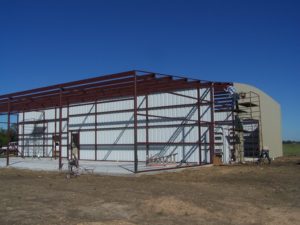
Barndominium Dividing wall between living area and shop
Wood buildings (commonly referred to as pole barns, pole buildings, or post framing) use large columns on the exterior to support roof trusses. Roof trusses can be highly functional, in the form of pre-engineered wood trusses, or highly decorative, in the form of heavy timbers.
Will you construct it, or can you find a company that can do so?
Depending on the type of metal building you choose, you may have the option of assembling it yourself. Will the time it takes you to be worth it? We have seen crews assemble the buildings in less than a week.
If you are considering doing it yourself, consider the equipment you will need to have handy to reach the required height for truss placement and what will elevate the trusses for you. If you don’t know anyone locally who has constructed one, search the internet for people who have so that you can ask about their experience.
If you are considering a kit building, get a list of customers in your area you can interview and hopefully view the building. You will want to see the width of the columns and whether they bend inward where they attach to the trusses. If they bend inward, that will affect your ceiling height, or be framed around and thus stick out into your living area.
If you decide to hire a contractor to build your Barndominium, finding local contractors with referrals from happy customers can save you a lot of time and a few headaches!
If you build it yourself, you can save by using Zac Screws the first time instead of nails, which eventually come out. (You will eventually replace them with screws.)
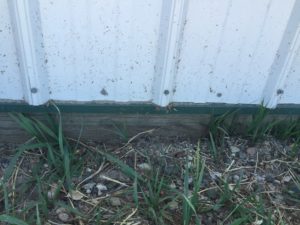
Barndominum Without Tin Ledge with Nails instead of screws
Water resistance: how sealed is it?
You want your metal roof to be as tight as possible. Some round roofs use complete panels over the entire building, whereas pitch roofs have a ridge vent that runs along the top where the two metal sheets meet. It is very important to install this correctly. Remember, sometimes it rains sideways.
The fasteners you choose also contribute to the water tightness now and in the years to come. Please avoid nails; they will eventually start to pull out.
Screwing your nails into the purlin is also very important. If you miss the purlin, you will need to seal that hole with something other than the screw, or else you will end up with a leak.
You may also consider using roofing felt paper over the top of your ceiling/insulation. The idea is that a small amount of water can fall on it and evaporate rather than absorb into your insulation and wood.
Column Size will determine the thickness of your external walls.
Whether you choose a pole barn, 2×6 barn, or bolt-together pre-engineered building, the external walls must be wider than the roof’s column. You can also frame around the columns or leave them exposed.
This will also determine how deep your window will be set into the wall. Imagine a 10-inch thick wall with a two-inch window, that will give you 4 inches on each side of the window or some combination of 8 inches.
Column Spacing (bay width): How strong would you like your home to be?
Your column spacing affects several things, the first of which is the strength of your home’s outer shell (framework). What is recommended for a barn may not meet your expectations or local code for a home.
The bay widths will also need to be considered when placing your windows and doors outside your building, as they cannot be located where a bay support is present.
If you live in an area with severe weather, consider a tighter bay spacing.
This column spacing also determines where you can’t have windows and doors, so your plans should match the bay spacing you choose.
If you are buying a kit-built or pre-engineered building, check on the availability of different bay spacings.
Column placement is essential when selecting your plans.
If your metal building for your Barndominium includes support columns, you will need to consider this. Will you hide them in interior walls? We offer barndominium layouts featuring a lean-to design, where the metal building incorporates center support columns concealed within the walls.
If you select a clear-span building, you will not have any support columns inside your structure.
Truss type: Will it be easy to place your walls inside?
The way your truss attaches to your columns will be essential to factor in when selecting your metal building. You will want to ensure that you have the necessary clearance for your ceiling supports to clear them.
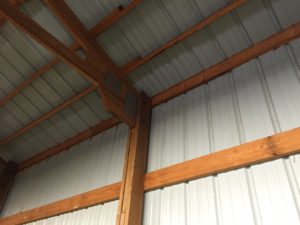
Pole Barn 2×6 Wood Barndominium framed Wall
Height: Would you prefer 8,9, or 10-foot ceilings and attic space?
If so, verify the height of the metal building trusses. You may want attic space for storage, or for AC and Heating ducting, or other mechanical systems.
Having enough room to work comfortably when building your barndominium may be reason enough to include some extra height. You may run your electrical wires and water pipes above your ceiling.
Will you have enough room to roll or blow insulation?
Will you have a larger Motorhome in the future? You will want your inside clearance to be high enough, along with an overhead door to match. (See our slab page for more on planning for a motorhome hookup.)
Wind and Snow Load: The pitch of the roof and the strength of the framework are important considerations.
This isn’t a hay barn, it is your home and shop, so make sure you consider the wind and snow loads that may come. Check your local codes to ensure you make the correct choices. Also, realize the doors and overhead doors you choose may be the weak link that enables significant damage. Doors rated for high winds are a great investment. Look for wind struts on your doors!
Are wood studs or gauge metal wall framing best for your area? Wood Studs Versus Metal Studs
Depending on where you live, you may have a choice between wood and steel frameworks. Consider the life of each, as well as any warranty that may exist. Treated wood buildings that are kept dry should last just as long as those in conventional homes.
It may be easier to frame your exterior walls when attaching them to a wooden structure. When attaching to metal purlins, have some drills handy. If you are running wires down exterior walls, you will need to drill through the metal purlin and then add conduit (such as PVC) to protect your wires from rubbing against it.
Metal Studs vs. Wood Studs for interior framing of a Barndominium.
- During the 2020 pandemic, the price of wood studs increased by 20%. People started considering metal studs to save money on their barndominium build. A common question is: “Are steel studs cheaper than wood studs?”. That all depends on the current prices. A better question to ask is: Are steel studs cheaper overall when used for the construction of a residential home, and will you be happy with metal studs in your home (usability/versatility)? If you answered “Yes”, then you need to find a builder who has framing crews who are familiar with metal stud construction.
- Metal Studs Benefits
- Termites will not eat them.
- Straight and consistent, No Crowns to consider
- With traditional lumber, good trades will consider the crown of each piece of lumber to determine how to place and where to use it. For Rafters and Floor Joists, the crown edge is typically placed up, with the rationale being that the lumber will sag over time.
- Walls are made of the straightest lumber. This is easy with steel studs because they are all straight.
- Depending on the gauge or thickness of the metal stud, 2×4 lumber can be installed at 24 inches on center rather than 16 inches on center. For some applications, 2×6 wood lumber can also be installed at 24 inches on center.
- Metal studs are Lighter weight than their wood counterparts.
- They do not burn.
- Metal Stud Considerations
- You cannot use nails to hang things on your walls.
- You need screws and maybe a drill bit.
- Can you use metal studs for load-bearing walls? Only if they are the thicker studs. See the ratings from the manufacturer. The cheaper studs do not support a ceiling in commercial applications. Drop ceilings are used instead.
- If you plan to have an attic or second floor, you will need metal studs that meet the load requirement for the the 2nd floor.
- The framers will need to have experience working with metal studs. These crews are almost always working on commercial projects, so your builder or general Contractor may not have access to one and might charge you more because of the unknowns that come with a new crew.
- Your electrician will need to run the electrical in conduit or use Plastic Stud Bushings to protect the wires from the sharp edges of metal studs.
- Metal Studs do not warp or rot. If galvanized, they should be rust-resistant.
- The thinner gauge metal studs are not used in load-bearing walls (This does open up the possibility of using a lot of metal studs for the interior build-out of your single-story barndominium.)
- You can only use Screws to build with metal studs.
- Can the studs support your cabinets? (You may need to use plywood in areas where you will be hanging cabinets and other heavier items like TVs)
- Will the cabinet installers be familiar with installing metal-framed walls?
- Do you know the strength and Axial load needed when using metal studs?
- Will a typical stud finder work on a metal stud? Some stud finders will detect metal studs, and some will not. A strong magnet can be used to locate steel studs.
- You cannot use nails to hang things on your walls.
- Wood Studs
- Easy to cut, drill, and notch with standard blades and bits.
- Residential Builders, Trades, and Contractors have more familiarity and experience with wood for residential home construction.
- Comes in many sizes.
- Easy to replace or repair by the homeowner or contractor.
- Available at local home improvement stores.
- Can use nails or Screws for construction.
- Can use nails and screws to hang photos, shelves.
- It can be used with no additional plywood to hang a wide range of items, from TVs to cabinets.
- As mentioned above, if you plan to hang or attach heavy things to your metal studded walls, you should line those studs with plywood or use metal studs to give a strong substrate to screw and nail to.
- Metal Studs Benefits
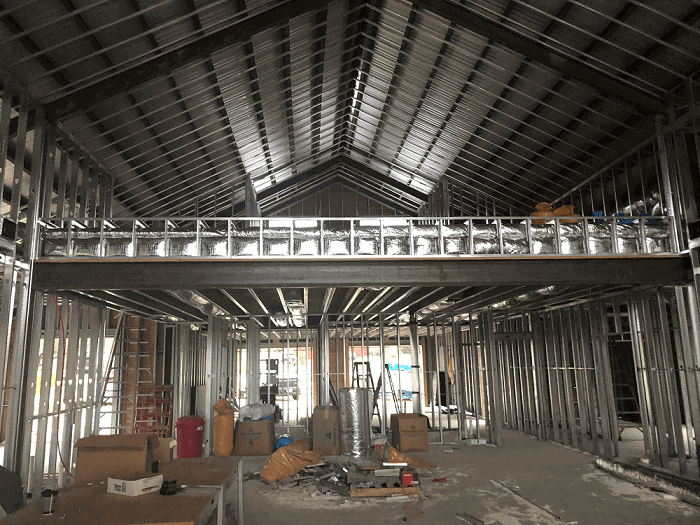
Virginia Barndominium with Metal Studs
When should you consider galvanized light-gauge metal for your wall framing?
Depending on where you build your Barndominium blueprints, you might benefit from the galvanized framework. This is especially true for porches, lean-tos, or roof extensions outside enclosed areas. If this is your beach Barndominium, price the framework with galvanized steel.
Do you need a pre-engineered building?
Check your country’s code requirements to see if a pre-engineered building is required. Additionally, if you are building in an HOA area, they may have specific requirements related to the construction of your building.
Will your sidewalls be a mix of metal, siding, or stonework?
Your exterior walls can be made of almost any material, just like a conventional home or a metal building. Do you want your home’s entrance to be made of stone or brick, while the rest of the exterior is metal? Perhaps you will have a few feet of metal siding coming down from the roof, followed by regular siding.
For your exterior walls that are NOT metal, you will attach a hardy cement board or OSB to the external walls you frame. Usually, there will be no metal purlins on these walls; instead, the framer will frame the exterior wall and tie it into the metal frame (as seen below).
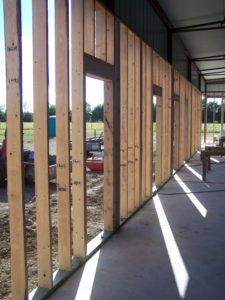
Barndominium 2×6 framed exterior wall